
Numbers App
Spreadsheet allow students to “get their hands dirty” when incorporated into classroom lessons. Principles to Actions states, “An excellent mathematics program integrates the use of mathematical tools and technology as essential resources to help students learn and make sense of mathematical ideas, reason mathematically, and communicate their mathematical thinking” (National Council of Teachers of Mathematics, 2018). Thus, spreadsheets promote abstract and complex models by providing real world examples students can analyze. They also provide quick results for complicated calculations and generate tables of values that promote insights into mathematical relationships and structures.
Spreadsheets are easy to implement into classrooms because it is a program students typically already have on their devices. It is an attractive technology that can be used in future projects, careers, and in students’ personal lives. Better yet, spreadsheets are relatively easy to use and are flexible. “Recently, spreadsheets have been developed that support computer algebra, making it possible to have symbolic computations in cells based on the symbolic content of other cells” (Dick & Hollebrands, 2011). Using a program such as spreadsheets forces students to think deeply using their own methods. Also, spreadsheets provide three main functions students can examine: exploring graphs, recording data, and grading organization.
Exploring Graphs
Students can collect data and use charts to create graphs. Their graphs can be easily shared and critiqued with fellow classmates. Graphs can be used to show relationships between numbers in a line, bar, and pie chart. Visualizing data, such as graphs, can help students gain better understanding of the data they are analyzing. Below is an example of a graph from a spreadsheet.

Recording Data
Spreadsheets are helpful for real world applications such as personal living expenses and budgeting. Information can be easily placed in columns and rows neatly. Spreadsheets are also beneficial when students work with repetitive calculations. For example, the Numbers App has an option where, when students plug in a formula, they can auto-fill all the way down, that way they aren’t wasting time filling formulas in every cell.

Grading Organization
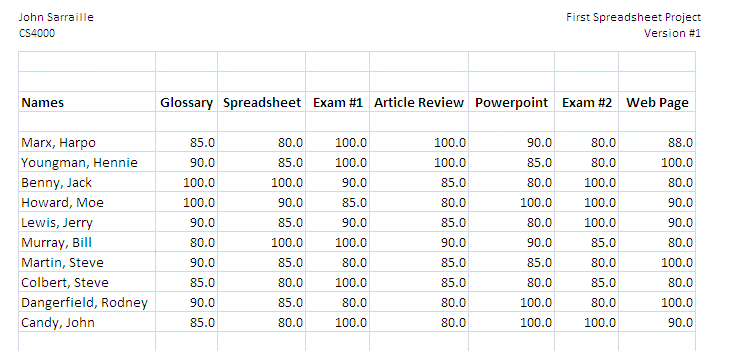
Students can record data such as homework, assignments and exam scores to keep up with their grades on their own. Teachers are constantly being hassled by their students when it comes to grades. By using a spreadsheet, students can view their progress any time they feel. When they can see their grades, it helps to motivate them to do better if for example, they get a bad grade. They can easily calculate what they need to do to be able to keep that letter grade they are striving to get.
“Technology is an inescapable fact of life in the world in which we live and should be embraced as a powerful tool for doing mathematics. Using technology can assist students in visualizing and understanding important mathematical concepts and support students’ mathematical reasoning and problem solving” (National Council of Teachers of Mathematics, 2014). Spreadsheets are a great example where students can gain better understanding and examine real world problems while exploring graphs, recording data and organizing their grades.
Resources
Dick, T., & Hollebrands, K.F. (Eds.) (2011). Focus in high school mathematics: Technology to support reasoning and sense making. Reston, VA: National Council of Teachers of Mathematics.
National Council of Teachers of Mathematics. (2014). Principles to actions: Ensuring mathematical success for all. Reston, VA: Author.
 Bree’s Mathematical Blog