Desmos is a online advanced graphing calculator that allows users to explore mathematics in new and exciting ways. Did I mention that it’s FREE?

Desmos-Click for more information
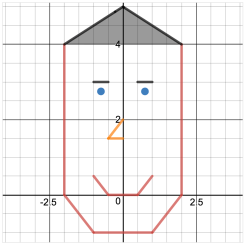
It is an interactive calculator that permits students to alter their functions to see different graphs, and learn what each function looks like. New standards in mathematics promote students to have a deeper understanding of conceptual mathematics and how they can be applied in the real world. Incorporating technology is an essential component of building this comprehension. According to Focus in High School Mathematics, “Technology can be used to rapidly produce accurate examples and linked representations, creating venues in which students can better understand by hand-work and learn new methods to solve fundamental problems” (Dick & Hollebrands, pp. 19). In addition to graphing both equations and inequalities, it also features lists, plots, graph restrictions, piece-wise function graphing, polar function graphing, and etc. Desmos provides many benefits for students and teachers. A few of these benefits include sliders, tables, and Activity Builders.
Sliders
Students benefit from the ability to use sliders as substitutes for variables. They can visually watch how the variables manipulate the graph which helps build intuition and understanding of the way plots react to changes in values. For example, when Algebra students are learning about slope-intercept form, they can type y=mx+b into Desmos and add sliders to view how the slope and y-intercept affect the graph.

Tables
Desmos’ tables allow students to plot input and output data for any function. Students can organize ordered pairs, quickly plot points for functions, or run regressions to find a line to best fit. Using tables, students can graph groups of numbers at the same time. Tables can also be used for statistics, regressions, and scatter plots.

Activity Builder
 Desmos Activity Builder provides teachers with the tools to create online classroom activities. Teachers can build a series of screens that walk a student through interactive activities. Through these activities, teacher may ask students to graph or answer questions based on a graph. While students work through the activity, teachers can monitor student progress and understanding when viewing the dashboard. At any time the activity can also be paused to clear any misconceptions. Desmos also provides already made activities teachers can choose from at any time. Click here to view The Desmos Guide to Building Great Math Activites for more information on creating Desmos activities. Lastly, tips for teachers will pop up, giving helpful ways teachers can assist their students while they work.

Desmos’ Marbleslides Activity
The iPad app can function offline as well, so students don’t need internet access to make use of the powerful features. Desmos can also be used in many mathematical subjects such as Algebra, Calculus, and Statistics. “An excellent mathematics program integrates the use of mathematical tools and technology as essential resources to help students learn and make sense of mathematical ideas, reason mathematically, and communicate their mathematical thinking” (National Council of Teachers of Mathematics, 2014, pp. 78). Graphing applications can help students examine multiple representations by generating graphs, tables, and symbolic expressions that are dynamically linked. Demos does a fantastic job helping students make sense of ideas and reason mathematically through using the sliders and table features. Desmos’ Building Activities also allow students to communicate their mathematical thinking while teachers monitor student understanding. Once again, sliders, tables, and Building Activities are only a few of the fantastic features of Desmos.
I highly recommend exploring Desmos some more.
Resources
Dick, T., & Hollebrands, K.F. (Eds.) (2011). Focus in high school mathematics: Technology to support reasoning and sense making. Reston, VA: National Council of Teachers of Mathematics.
National Council of Teachers of Mathematics. (2014). Principles to actions: Ensuring mathematical success for all. Reston, VA: Author
 Bree’s Mathematical Blog