 Hello, and welcome back to Bree’s Mathematical Blog! Today we will be discussing some characteristics of calculator and why it is important for students to have access to them in classrooms. A calculator can be defined as, “also called calculating machine; a small electronic or mechanical device that performs calculations, requiring manual action for each individual operation” (Calculator, 2018). Calculators are somewhat of a debate in the Education world because, on one hand, teachers want their students to be familiar with the technology available to them, but students shouldn’t rely solely on technology, such as calculators. We will be discussing the history of calculators, the different types of calculators, and the pros of using calculators in the classroom.
History
The first tool for the use of mathematical computations was the abacus. “The abacus was a table of successive columns with beads or stones representing a single unit, which could be used for addition and subtraction” (The Calculator: A Brief History, 2017).  Other cultures such as the Chinese eventually refined this device to improve its dynamics. In 1642, the first true calculator was invented by Blaise Pascal. It performed calculations using a clockwork-type of mechanism. However, these calculators were very difficult to produce, therefore very few were made. Next, “Curt Herzstark invented the first handheld, mechanic calculator in 1945, from a design he had created in 1938. Shaped like a stout pepper grinder, the Curta calculators were produced in large quantities until 1970 when a company in Japan invented the first digital pocket calculator and the demand for the antiquated device faded” (The Calculator: A Brief History, 2017). Not only have calculators enhanced the ability to perform computations involved in everyday life, but it has provided people with the ability to understand mathematics on a greater scale.
Types of Calculators
Four-Function Calculator: Basic calculators can perform operations such as addition, subtraction, multiplication, and division. Students can use basic calculators for problems involving percentages and square roots. These calculators are suitable for primary school aged students because of their simplicity.
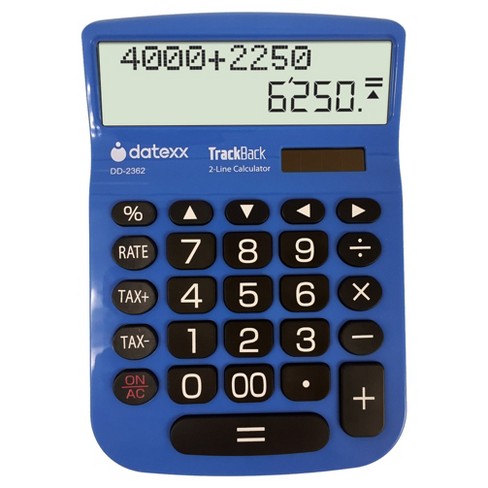
Basic calculator
Scientific Calculator: “By definition, a scientific calculator is a calculator designed to help you calculate science, engineering, and mathematics problems” (Alcocer). Modern scientific calculators have many more features than a standard four or five-function calculator. Scientific calculators allow students to work with various problems involving: trigonometry, pi, logarithms, and probability. Although I mentioned a few types of problems, those aren’t the only ones scientific calculators can be useful for. These can be used in mathematics classrooms at the junior high level all the way up to college and they are generally permitted or required on many standardized tests in subjects such as math and science.

Scientific calculator
Graphing Calculator: A graphing calculator is a handheld computer that is capable of plotting graphs, solving equations, and performing other tasks with variables. Some graphing calculators have a compute algebra system. These are typically called symbolic or CAS calculators. Graphing calculators are also a mathematical action technology. A mathematical action technology is defined as, “those that can perform mathematical tasks and/or respond to the user’s actions in mathematically defined ways” (Dick and Hollebrands, 2011, pp. xii). It allows students to examine multiple representations of functions and data. Graphing calculators are typically used in high school and college level mathematical courses.

Graphing calculator
Pros of calculators in the Classroom
We live in a society that is always changing thanks to the advancement of technology. Therefore, technology such as calculators is an important instrument that students will be able to use throughout their lives. “Computers and calculators were invented to save humans time and to allow us to solve more challenging problems more easily than we could do otherwise” (Steely, 2006). Another pro of calculators is that they are fast and accurate which is very convenient tool for students. For example, students can complete a set of problems and then check to see if their solutions are correct using a calculator. Calculators also allow students to have access to mathematical concepts and experiences from which they were previously limited with pencil and paper.
In conclusion, when students don’t have to worry about computation mistakes, they can focus on reasoning and problem solving. Teachers can also help students see patterns and solve complex problems. Even young students can use calculators to focus on the ideas behind computations rather than the act of calculating. The great thing about calculators is their only use isn’t just in the classroom. Everyone from physicists, to engineers, and architects make use of calculators such as the ones mentioned above. You have read over some of the history pertaining to calculators, the different types of calculators, and the pros in the classroom. Now it’s your turn! Do some research on the calculator that best fits your needs and goals and see what you come up with.

Resources
Alcocer, Y. Y. (n.d.). A Scientific Calculator. Retrieved November 25, 2018, from https://study.com/academy/lesson/what-is-a-scientific-calculator.html.
Calculator. (n.d.). Retrieved November 25, 2018, from https://www.dictionary.com/browse/calculator.
Dick, T., & Hollebrands, K.F. (Eds.) (2011). Focus in high school mathematics: Technology
to support reasoning and sense making. Reston, VA: National Council of Teachers of
Mathematics.
The Calculator: A Brief History. (2017, March 29). Retrieved November 25, 2018, from https://www.schoolmart.com/2017/03/29/the-calculator-a-brief-history/.
Steely, C. (2006, March). Technology Is a Tool. Retrieved November 25, 2018, from https://www.nctm.org/News-and-Calendar/Messages-from-the-President/Archive/Cathy-Seeley/Technology-Is-a-Tool/.
 Bree’s Mathematical Blog